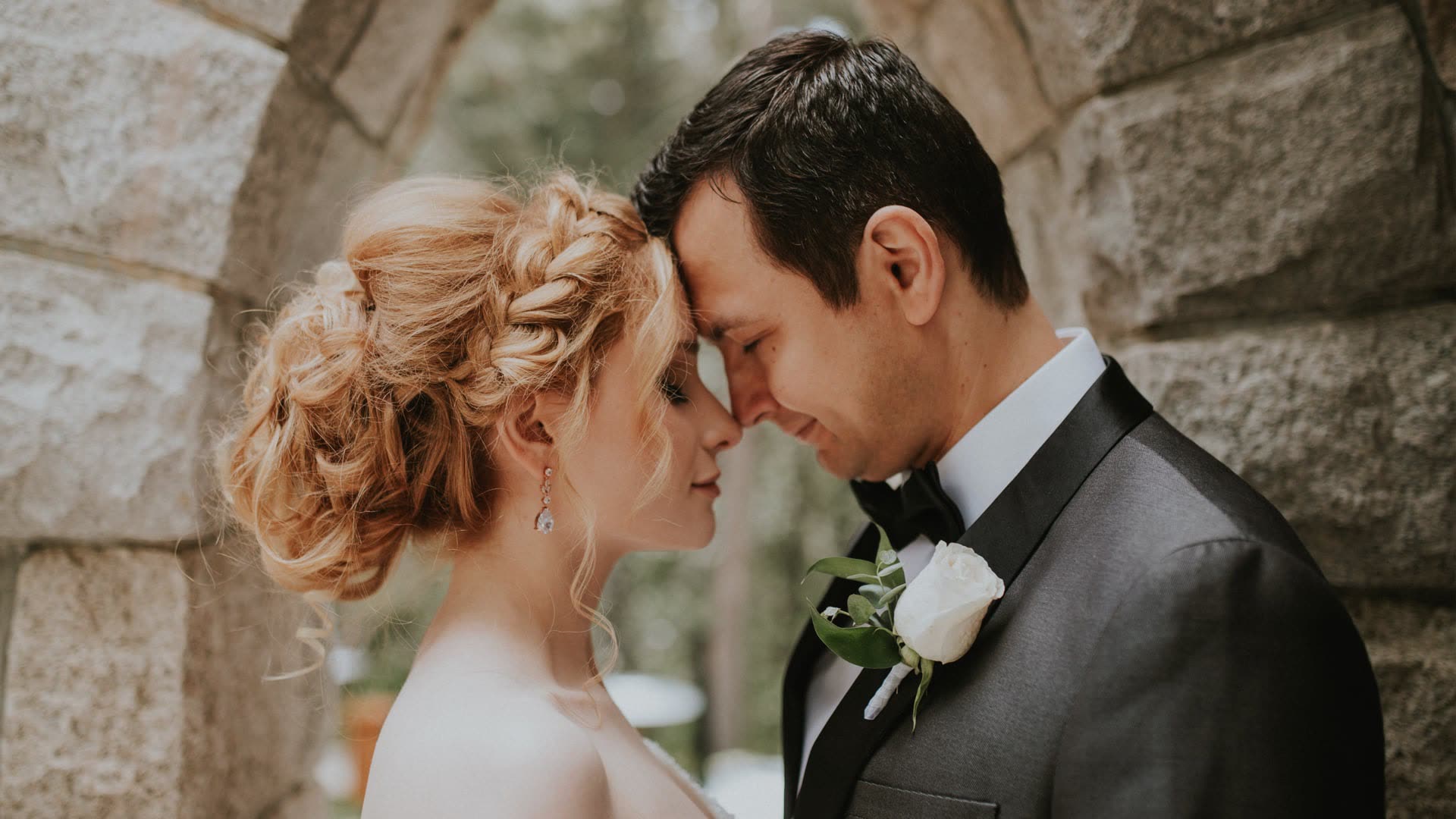
Notes on the light
Everything at SkyPark happens under pine canopy, at around 5,700 feet in the San Bernardino Mountains, and the canopy decides your exposure before you have made a single choice. Direct sun does not arrive as a wash here. It arrives in columns, and it lands on faces in bands: a bright stripe across a forehead, a dark eye socket half an inch away. The fix is not a bigger light. The fix is placement. We put people in clean shade and let the lit patches fall behind them, and we carry more bounce up here than we would at a coastal venue.
The other problem is the ridge. A published sunset time assumes a flat horizon, and you do not have one. Direct sun leaves the ceremony ground before the clock says it should, and it goes quickly. What follows is the light worth planning for: the tops of the pines still lit, the ground in open shade, cool and even and kind to skin. It does not last. If you want portraits in it, you need to already be standing where you want to be when it starts.
One colour note. Green spill off the pines lands on skin, and it is stronger than it looks through the viewfinder, particularly on anyone in white. We warm the key a little in camera rather than fixing all of it in the grade, because the moment you pull green out of faces you also pull it out of the trees behind them, and the trees are the reason you came up here. It is easier to keep the forest honest and correct the skin.
The spaces, and how they film
The Creekside Ceremony site. The venue’s own description pairs the ceremony with flowing water and towering pines, and that is what you get: water on one side, trunks behind, no built architecture competing for attention. It films well on longer glass. Because the background is all vertical lines, a wide lens flattens it into wallpaper, so we shoot the ceremony tighter than we would elsewhere and leave one wide locked off at the back. Check your footing near the water as well, and check the tripod again before the processional rather than after.
The Whispering Pines Terrace. The reception terrace is a short walk down a forest path and over a creek. Zola and Here Comes The Guide both list it at up to 250 seated, while the venue’s own collections page mentions up to 300 guests, so confirm your own number in writing. The collections page also describes the space lit with bistro lights, which is the practical detail that matters: once the sun is gone, those lights are your key, and they are warm and overhead. Faces get top light and eye sockets go dark. We add a small warm source at head height off to one side, match its colour to the bistro string, and never fight it with anything white.
The Reindeer Room. The venue describes this one as an alpine speakeasy inspired space, used as an elevated cocktail party rather than a seated dinner. Treat it as a low-light room and plan accordingly: fast glass, a high native ISO, and whatever practicals are already burning. Adding a light to a room built to feel dim announces the camera to everyone in it, so we would rather shoot it handheld, wide open, and accept the grain. It cuts well against the daylight material.
The Chapel of the Little Shepherd. Originally constructed in 1955 and since restored, the chapel is available for simple ceremonies and for signing the marriage certificate. It is small: listings put indoor ceremony capacity at 12 seated. A second operator changes the geometry of a room that size simply by standing in it, so we plan for one camera on sticks at the aisle, a locked second at the back, and no movement at all once things begin. If you want coverage from more angles than that, sign here and hold the full ceremony outside.
Sound, and the water under it
There are small waterfalls near the ceremony area, and a review on the venue’s own site credits them with the background sound. That is a fair description of what they do to a guest. They do something else to a recording. Moving water is broadband, it sits directly under the speech frequencies, and it cannot be taken out later without taking the voices with it. We run ceremonies here on lavaliers: one on each partner, one on the officiant, plus a separate recorder placed near the ceremony arch. A camera-mounted microphone on its own will not survive the mix.
Outdoor amplified music is permitted at the venue, so a proper ceremony sound system is worth the line item rather than a compromise. Two further notes. SkyPark is a working adventure park with nearly 10 miles of year-round mountain bike trail across its 230 acres, so scout your ceremony position on a normal operating day rather than assuming silence. And wind through the tops of the pines is worth planning for. Deadcats on everything, lavs included, and check them again after the portrait walk.
The films, so far
We have made one film at SkyPark: Peter & Julya. One wedding under canopy this dense is enough to learn how the light actually arrives: in shafts rather than a wash, moving fast, and gone from the forest floor well before it is gone from the sky. The second film at a venue is always better than the first, and we would like it to be yours.
Timing the day
Build the timeline backwards from the moment direct sun leaves the ceremony ground, not from the sunset time on your phone. On this property those can be two different things. Practically, put the ceremony far enough ahead of that moment that the vows sit in warm side light and the portraits land in the even shade that follows. Wedding season here runs May through October, so you always have long days to work with, but the canopy and the ridge take a real bite out of the end of them.
Then plan the drive, because it is the thing that goes wrong. Highway 18 climbs steeply out of the valley, and Skyforest sits roughly 75 miles east of Los Angeles at an elevation of 5,741 feet. Build margin into the morning for anyone coming up that day. We ask hair and makeup to be on the mountain the night before, and we come up the day before ourselves, so the first hour of the morning is not spent unloading. Guests underestimate it too. Say so on the invitation.
Two smaller things. Do not schedule a portrait walk immediately after the ceremony: the path to the terrace crosses a creek, and the climb back up takes more out of people at this elevation than it looks like it will. Give them ten minutes. And confirm your end time in writing. Venue listings put the available window at 11am to 10pm, with some days ending at 8pm, and the last twenty minutes of a night are where the exit, the final dance and the goodbye all get compressed if nobody checked.